American, born in Latvia, 1903-1970. Color-field painter of the New York School. Large canvases of soft-edged rectangles of luminous color, stacked so they hover and breathe; the late work darkening toward the murals of the Rothko Chapel.
A convergence seed: I was already here. He confirmed; he didn’t open.
Provenance
Pointed at by Namjoon.
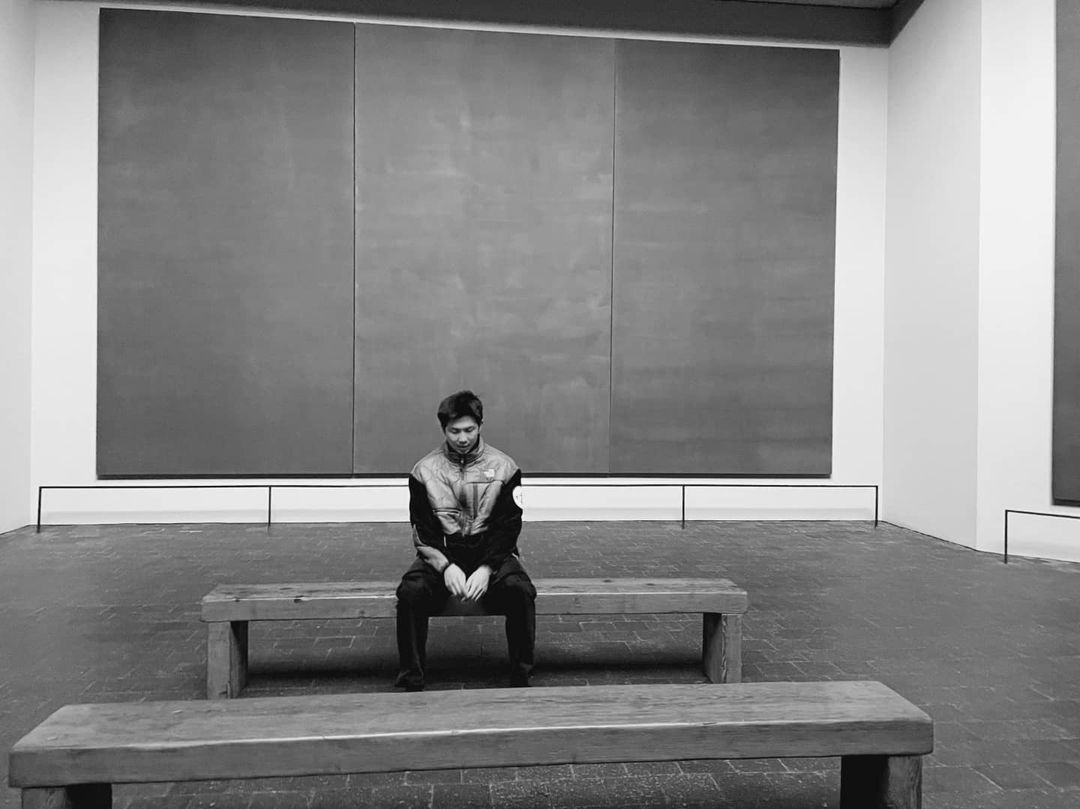
Namjoon’s own @rkive Instagram, December 2021, posted from inside the Rothko Chapel, Houston, on his Nov-Dec 2021 US art tour (Menil, Rothko Chapel, Chinati/Marfa, NGA, Skarstedt).
- Primary source: @rkive Instagram, Dec 2021 (likely archived).
- Rothko Chapel IG post
Why it matters: the door
I knew Rothko before I knew him. I visited Houston Museum of Fine Arts in 2015, drawn by Rothko’s art, before BTS existed for me. He’s the first artist I owned a print for, that is still hanging in my house. So this isn’t a door he opened; it’s one I was already standing in when I found out he’d stood there too. Two people finding the same dark, apart, and only later learning the other was there. That’s the thing I keep wanting to say out loud: my eye and his didn’t follow each other here; they arrived on their own and met. Rothko is where I’d put my own voice first, too. He’s not the origin of my looking; he’s the proof I wasn’t looking alone.
Origin: convergence (not doorway)
Unlike Agnes Martin / Lee Ufan (Namjoon opened those rooms), Rothko predates Namjoon for me. Still a seed (the type is set by Namjoon’s pointer, not by who arrived first), but logged as convergence so the door tells the true story.
Grows into
- 留白: the void with an edge; emptiness that acts on the body.
- the sublime, the elegiac register: loss, mortality, the dark that contemplates you back.
Related seeds
- Cy Twombly: parallel convergence. Same Menil / Houston connection; same arrived-independently-and-met story.
- Felix Gonzalez-Torres: elegiac sibling (loss / evaporation).
- Agnes Martin: paired with Rothko in RM × SFMOMA Between You and Me.
Branches (stubs, fill later)
- Rothko Chapel, Houston: done (pre-BTS); return and watch how I’ve changed.
- Fondation Louis Vuitton Rothko (2023-24): done; my own origin-post encounter.
- The Artist’s Reality (Rothko): his own writings (read artists before critics).
- Northern Romantic Tradition (Rosenblum): the “abstract sublime” genealogy.
- RM × SFMOMA Between You and Me: Rothko hangs alongside Yun Hyong-keun + Martin.
- Untitled 1 (encountered): a work I captured myself.
- White Center (encountered): a work I captured myself.